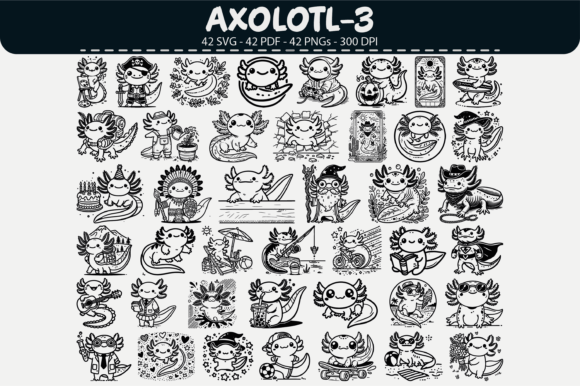
Axolotl Clipart Pack – 42 Designs
First Impressions: Playful, Precise, and Ready for Stitching
As someone who’s digitized hundreds of embroidery files and stitched everything from boutique baby onesies to Etsy bestsellers, the Axolotl Clipart Pack – 42 Designs landed with a quiet kind of charm—not flashy, but deeply intentional. These aren’t cartoonish blobs or over-simplified icons. They’re clean, expressive illustrations with subtle personality: gentle curves, balanced negative space, and just enough detail to read clearly at 2–3 inches tall—ideal for an embroidered tote bag, a nursery pillow cover, or a soft sweatshirt front. The mood is warm, curious, and quietly joyful—perfect for handmade product lines that value authenticity over trend-chasing.
Real-World Test: A Custom Embroidered Baby Onesie
Last week, I prepped a client order: six organic cotton newborn onesies, each with a different axolotl design centered on the chest. I pulled three files from the Axolotl Clipart Pack – 42 Designs, resized them to fit a 3.5" hoop, and ran test stitches on scrap fabric first. What stood out immediately was how well the shapes held up in satin stitch—no jagged edges, no awkward gaps between limbs and body. The clean vector outlines translated smoothly into stitch paths. On lightweight knit, I used medium-weight tear-away stabilizer; on the thicker bamboo blend, I added light cut-away underneath. All six stitched cleanly—no puckering, no thread breaks. Parents loved the whimsy; the onesies sold out in 48 hours on the client’s Etsy shop.
Where This Pack Shines (and Where It Needs Care)
The Axolotl Clipart Pack – 42 Designs excels in projects where clarity and character matter more than photorealism: embroidered patches, tea towels for a science-themed kitchen shop, minimalist aprons for a small-batch bakery, or holiday gift tags for a biology teacher. It works beautifully on stable fabrics like denim, canvas, linen, and midweight cotton—especially when paired with soft pastel or earth-tone thread colors.
That said, use caution on:
- Stretchy or thin fabrics—like jersey or rayon challis—without proper backing and reduced stitch density;
- Curved surfaces such as caps or curved baby hats—some designs with tight corners or fine legs may need manual digitizing tweaks;
- Dark or textured fabrics—test contrast early; a pale yellow axolotl can vanish on charcoal fleece without careful thread selection;
- Small hoop sizes under 3"—while many designs scale down well, the most detailed variants (like those with tiny gills or speckled patterns) lose legibility below 2.25".
Design Integrity Meets Commercial Practicality
What makes this pack valuable for craft businesses isn’t just quantity—it’s consistency. All 42 designs share the same visual language: friendly proportions, balanced weight distribution, and thoughtful spacing. That means your Etsy listings feel cohesive, your boutique branding stays recognizable, and your customers instantly associate your handmade product with warmth and attention to detail. When buyers see a set of matching embroidered napkins, a matching patch, and a printable mockup using the same axolotl style, trust builds—not because it’s “cute,” but because it feels intentionally designed, not assembled.
I’ve seen too many digital embroidery files fall apart at the seams: inconsistent line weights, overlapping paths that cause double-stitching, or overly dense fill areas that stiffen fabric. The Axolotl Clipart Pack – 42 Designs avoids those pitfalls. Its clean SVG and PDF structure suggests it was built for adaptability—not just cutting machines, but as source material for professional digitizing. If you plan to turn these into machine embroidery designs, they’ll save time in the prep stage. Just remember: SVG files aren’t embroidery files out of the box. You’ll still need to digitize for stitch type, underlay, pull compensation, and fabric-specific tension.
Practical Notes Every Embroidery Designer Should Keep Handy
Before stitching—or listing your finished product—take these steps:
- Always test on scrap fabric that matches your final garment’s weight, stretch, and texture;
- Check thread color contrast in both natural and artificial light—what reads well on screen may blur on dark fabric;
- Review stitch density if converting to embroidery format; high-density fills work for decor items but can stiffen baby clothes;
- Confirm hoop size compatibility—some designs may need slight scaling to avoid trimming on smaller hoops;
- Inspect small details like gill filaments or eye highlights—they’re charming, but can disappear if shrunk too far or stitched too densely;
- Test black-and-white mockups to assess silhouette strength—this pack holds up well, but always verify;
- Use appropriate stabilizer: tear-away for stable wovens, cut-away for knits, and water-soluble for delicate layers;
- Verify licensing before selling finished items or digital embroidery files—this pack includes SVG and PDF files, but commercial use rights depend on the seller’s terms, not file type alone.
Final Thought: A Thoughtful Asset, Not Just a Trend
The Axolotl Clipart Pack – 42 Designs isn’t a one-season novelty. It’s a versatile set of Illustrations that supports storytelling—whether you’re building a science-loving kids’ brand, launching a line of nature-inspired kitchen Graphics, or adding personality to custom apparel. It respects the craft: simple enough to stitch reliably, distinctive enough to stand out, and flexible enough to grow with your business. For embroidery designers and small shop owners who care about how a design *feels* after it’s stitched—and how it lands with real customers—this pack earns its place in the working library.