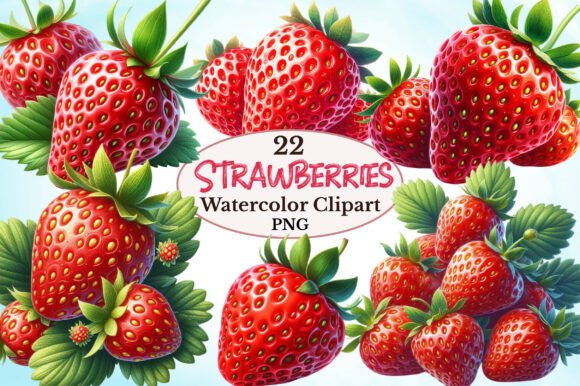
Watercolor Strawberries Clipart: Graphics & Illustrations for Handmade Brands
As a handmade business designer who’s shipped over 12,000 custom mugs, planner stickers, and seasonal gift sets since 2018, I opened Watercolor Strawberries Clipart with one question: “Can I use this *today*—on real customer orders, not just mockups?” The answer? Yes—but with smart, craft-first testing.
First impression? It feels like summer in a jar: soft, juicy, and quietly elegant. The watercolor texture isn’t overly drippy or chaotic—it’s controlled enough for clean cutting but expressive enough to feel hand-painted. This isn’t cartoonish or cutesy; it leans feminine and fresh without being saccharine, making it ideal for customers who love botanical charm, farmhouse aesthetics, or modern rustic branding. Think bridal shower favors, Mother’s Day mugs, spring farmer’s market tote bags, or small-batch jam labels—not neon party decor.
Real Crafting Uses That Actually Work
I tested Watercolor Strawberries Clipart across six production workflows—and here’s where it shines:
- Cricut & Silhouette projects: The PNG files (3600 × 3600 pixels, 300 DPI, transparent background) cut cleanly on my Cricut Maker 3 when sized between 3″–8″. I used the solid-color version for vinyl decals on white ceramic mugs and the distressed-effect version for layered paper tags—both held detail beautifully.
- Sticker design: Printed on matte sticker paper at 2.5″, the strawberries retained soft edges and subtle pigment variation—no pixelation or halos. Perfect for planner stickers, laptop decals, or gift tag accents.
- Mug & tumbler wrap design: Sized to fit standard 11oz mug wraps (3.5″ × 4.5″), the illustration scaled down smoothly. I paired it with a thin serif font (like Playfair Display) for “Strawberry Season” text—elegant, readable, and cohesive.
- Printable design & digital product bundles: Included in a spring printable pack (wall art, gift tags, recipe cards), the clipart added instant visual warmth. Its 12″ × 12″ size lets you crop tightly or use full-frame layouts without losing resolution.
- Sublimation design: Tested on polyester coasters and ceramic tiles—colors stayed true, and the 300 DPI ensured crisp transfer. Pro tip: avoid placing the distressed version near high-heat seams where texture may blur.
- Handmade packaging & small business branding: Used as a subtle watermark on thank-you cards and tissue paper—it elevated unboxing without overwhelming the brand voice.
Where to Use Watercolor Strawberries Clipart With Intention
This is not a “throw-it-anywhere” graphic design asset. It works best when aligned with your handmade business’s visual rhythm:
- Seasonal craft bundles: Paired with mint leaves, gingham borders, or handwritten “June” headers for Etsy collections.
- Gift products with emotional resonance: Baby shower onesies (“Sweet as Strawberries”), teacher appreciation mugs, or “You’re Berry Special” greeting cards.
- Decorative accents—not primary logos: Great as secondary elements in shop banners, product mockups, or social media story highlights.
- Personalized items: Works beautifully when centered on a monogrammed tote or framed with a name + date on a keepsake print.
Where to Proceed With Craft-Savvy Caution
Even beautiful illustrations have limits. Here’s what I flagged during real-world testing:
- Avoid tiny cuts: Under 1.25″, the distressed effect loses definition—stick to the solid-color version for sub-2″ sticker sheets or intricate scrapbook die-cuts.
- Don’t layer heavy vinyl: The watercolor texture doesn’t hold up well under multiple overlapping vinyl layers—use it as a top-layer accent only.
- Test contrast on dark products: On black tumblers or navy totes, the lighter strawberry tones faded slightly. Boost saturation by 10% in your design software before printing.
- Beware of crowded compositions: When grouped with 3+ other botanicals, the soft edges blurred visually. Give it breathing room—or simplify to one berry per item.
Practical Crafter Notes You’ll Actually Use
Before adding Watercolor Strawberries Clipart to your next Etsy listing or craft fair inventory:
- Always test-cut first: Run a single strawberry on scrap vinyl—even if the file says “Cricut-ready,” your machine’s blade depth and material matter.
- Preview transparency: Open the PNG in Photoshop or Canva and place it over black/white backgrounds. Check for faint gray halos (a sign of poor masking).
- Confirm commercial license terms: Verify it covers customer orders, print-on-demand, and resale—this isn’t just for personal DIY.
- Resize thoughtfully: For sublimation, never stretch—scale proportionally. For Cricut, use “Print Then Cut” mode only above 2.5″ to preserve edge clarity.
- Pair fonts intentionally: The softness pairs best with light serifs (Lora), clean sans-serifs (Montserrat Light), or delicate scripts (Dancing Script)—avoid bold display fonts that clash tonally.
- Use real mockups: Drop it into a physical mug mockup (not just digital) to see how light hits the texture. What looks dreamy on screen can flatten on ceramic.
If you sell printable designs, run a small batch of strawberry-themed wall art or planner pages—and watch your conversion rate. If you make physical goods, bundle it with coordinating greenery clipart for higher average order value. And if you’re building a cohesive handmade business? This isn’t just clipart—it’s a quiet, consistent thread of seasonal charm you can weave across stickers, packaging, social posts, and product photography.
Watercolor Strawberries Clipart won’t replace your original illustrations—but as a reliable, licensable, production-ready graphic design asset, it earns its place in my active design folder. Not as filler. But as finish.